Who invented the barcode?
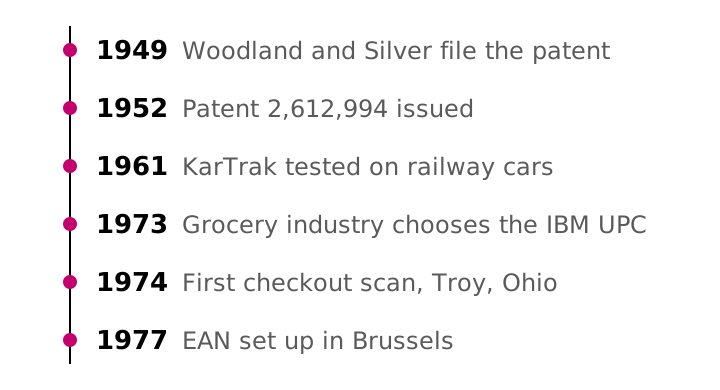
Three different people get the credit, and each deserves part of it. Norman Woodland and Bernard Silver filed the first barcode patent on 20 October 1949. George Laurer's team at IBM designed the UPC that the grocery industry chose in 1973. The first checkout scan rang up a pack of Wrigley's gum on 26 June 1974.
By the UPC Generator team. Written from the patent text on Google Patents, the IEEE Milestone record and the Smithsonian's object records and magazine. IBM's history page, GS1's history pages and Wikipedia's articles on the people fill in the rest. Where those sources disagree on a date, both dates are given. Last updated 4 November 2026. How UPC Generator pages are made.
A question overheard at Drexel
The story starts in 1948 at the Drexel Institute of Technology in Philadelphia. Bernard Silver, a graduate student, overheard the head of a grocery chain asking a dean for a way to read product information at the checkout. Silver took the problem to Norman Woodland, a Drexel lecturer who had worked on the Manhattan Project. Their first attempt used ultraviolet ink, which faded.
Woodland then left teaching and moved to a relative's apartment in Florida to work on it alone. He knew Morse code, and the idea he later described was to stretch its dots and dashes downward into thin and thick bars. He drew the first pattern with his fingers in the sand. To let a scanner read it from any direction, he bent the lines into a circle. That is the bullseye pattern that appears in the patent.
The patent
Woodland and Silver filed their application on 20 October 1949. US patent 2,612,994, titled Classifying apparatus and method, was issued on 7 October 1952 with 11 claims. The text never uses the words bar code or bullseye. It describes a pattern of lines read by a photosensitive device, with a line present counting as 1 and absent as 0. It also describes a circular version that needs no orientation. One application it names is the supermarket, while saying the invention is not limited to that field.
The reading hardware of the day made the idea impractical. Woodland's prototype used a 500 watt bulb and a photomultiplier tube. The two sold the patent to Philco for $15,000, and Philco sold it on to RCA. Accounts differ on whether that first sale happened in 1952 or 1962. Wikipedia, citing the New York Times, says the $15,000 was all the inventors ever earned from it. The patent expired in 1969. In 2012 the IEEE placed a milestone plaque at Drexel marking the site where the discussions of 1948 took place.
Railways scanned first
The first barcodes in daily use were on railway cars, not groceries. David Collins, who had studied at MIT, built a system called KarTrak at GTE Sylvania. Its blue, white and red reflective stripes carried a four digit company code and a six digit car number. Tests ran on the Boston and Maine Railroad in 1961, and the Association of American Railroads made it a requirement in 1967. Dirt on the plates made reading unreliable, and the railroads dropped it around 1977. Collins left to found Computer Identics, whose helium-neon laser readers went to work in 1969, one of them at a General Motors plant in Michigan. Wikipedia also notes a 1962 report that British Railways had a working system for reading rolling stock.
The UPC contest
In 1970 the US grocery industry formed a committee to choose one product code, with McKinsey consultants running the process. RCA, which held the rights to the Woodland patent, tested a bullseye code in a Kroger store in Cincinnati from July 1972. Ink smeared along the direction of printing and distorted the circles.
IBM answered with a rectangular code. George Laurer led the design, and Woodland, who had joined IBM in 1951, was the planner who helped write the proposal. Heard Baumeister worked out the label geometry and William Crouse devised the Delta C encoding. David Savir added the error detection digits, and Murray Eden chose the numbers printed under the bars. The symbol IBM presented had 95 modules, and it is the UPC-A still scanned today. The committee chose it in the spring of 1973. Smithsonian Magazine gives the date as 30 March, IBM as 1 April and GS1 as 3 April. That choice is the event GS1 dates its own history from. The symbol they chose is explained in what a UPC code is.
The first scan
On 26 June 1974, at the Marsh supermarket in Troy, Ohio, a Spectra-Physics scanner built with NCR read the first product at a checkout. Cashier Sharon Buchanan scanned it, and the shopper was Clyde Dawson, Marsh's head of research. Wikipedia gives the time as 8:01 a.m. and the item as a 10 pack of Wrigley's Juicy Fruit, rung up at 67 cents. The Smithsonian's own record says only that the item was Wrigley's chewing gum. The gum stayed with Dawson and never came to the museum, though a facsimile was once displayed.
Adoption was slow. IBM says retailers needed the code on at least 75 percent of items to break even. In 1976, as Wikipedia records, Business Week called it the supermarket scanner that failed. Today GS1 says its barcodes are scanned more than 10 billion times a day.
The three inventors
Woodland was born in Atlantic City in 1921 and died in 2012 at 91. He received the National Medal of Technology in 1992 and entered the National Inventors Hall of Fame in 2011. Silver was born in 1924 and died in 1963, at 38, before any of it reached a store. Laurer was born in New York in 1925, retired from IBM in 1987 and died in 2019 at 94.
What came after
The European EAN code, compatible with the UPC, arrived in 1977. The US and European bodies merged into GS1 in 2005, as the GS1 barcode guide describes. GS1 US dates the first two dimensional barcode, Code 49, to 1987, and today's 2D barcodes are the next step for the checkout. The number itself is now called a GTIN, and the UPC generator draws it the way Laurer's team specified.
What those inventors built is taken apart in how barcodes work.
More about the barcode's history
Who holds the first barcode patent?
Norman Woodland and Bernard Silver, two Drexel graduates, who filed US patent 2,612,994 on 20 October 1949. It was granted on 7 October 1952 and covered a pattern of lines and a circular pattern read by a photosensitive device.
Who invented the UPC?
George Laurer at IBM designed the rectangular UPC symbol, with Woodland on the team as planner. Heard Baumeister worked on the label geometry, William Crouse on the Delta C code and David Savir on error detection.
What was the first product scanned?
A pack of Wrigley's Juicy Fruit gum, at the Marsh supermarket in Troy, Ohio, on 26 June 1974. It was rung up at 67 cents by cashier Sharon Buchanan. The gum itself never reached the Smithsonian, which once displayed a facsimile.
How much did the inventors make?
Woodland and Silver received $15,000 from Philco for the patent. By Wikipedia's account, citing the New York Times, that was all they ever made from it. The patent expired in 1969, five years before the first checkout scan.
12 source documents
- Google Patents: US 2,612,994, Classifying apparatus and method, fetched 2 November 2026
- IEEE, Engineering and Technology History Wiki: Milestones: Birthplace of the Bar Code, 1948, fetched 2 November 2026
- Smithsonian National Museum of American History: Supermarket scanner, object record, fetched 2 November 2026, archive copy of 24 May 2025
- Smithsonian Magazine: The history of the bar code, fetched 2 November 2026, archive copy of 12 October 2026
- IBM: The UPC, fetched 2 November 2026
- GS1: How we got here: 50 years of GS1, fetched 2 November 2026
- Wikipedia: Barcode, history, fetched 2 November 2026
- Wikipedia: Universal Product Code, fetched 2 November 2026
- Wikipedia: Norman Joseph Woodland, fetched 2 November 2026
- Wikipedia: Bernard Silver, fetched 2 November 2026
- Wikipedia: George Laurer, fetched 2 November 2026
- Wikipedia: KarTrak, fetched 2 November 2026