What is a GS1 barcode?
A GS1 barcode is a symbol from the family GS1 standardizes, carrying a number that GS1 licensed, usually a GTIN. GS1 says its barcodes are scanned more than 10 billion times a day. The number inside is what GS1 licenses; the bars can be drawn by any software that follows its rules.
By the UPC Generator team. Taken from GS1's own pages and the GS1 General Specifications, Release 26.0. The sizes and symbols come from the sections named in the list of documents. Last updated 4 November 2026. How UPC Generator pages are made.
GS1 in one paragraph
GS1 is the organization that keeps the barcode standards used in retail and licenses the numbers behind them. Its own history starts on 3 April 1973, when US grocery leaders agreed on a single product code. The first pack scanned at a checkout was Wrigley's gum on 26 June 1974. The US Uniform Code Council ran that code, and EAN did the same in Europe from 1977. The two merged in 2005 to form GS1 with 101 local member organizations. Today GS1 says it works through member organizations in more than 120 countries and that more than 2 million companies use its standards.
What makes a barcode a GS1 barcode
Three things have to be true. The number inside is a GS1 key, most often a GTIN for a product. It was licensed through GS1 to the company that owns the product. The symbol is one of the data carriers GS1 has approved, listed in the family table. And the data is laid out in one of GS1's syntaxes, which for a plain product code means the digits and nothing else.
The picture is not what GS1 licenses. A UPC drawn by a label printer, by GS1's own Data Hub or by the UPC generator is the same GS1 barcode. That is so if the number is the same licensed number. Turn that around and it also holds: a perfect EAN-13 symbol wrapped around a made-up number is not a GS1 barcode. A retailer that checks the number against GS1's records will treat it as invalid.
A GS1 barcode also carries no price and no product name. The store's system looks the number up and returns those. Some members of the family can add a batch number, an expiry date or a serial number next to the GTIN. The price always stays in the database.
The family and where each one belongs
| Barcode | Holds | GS1's rule for it |
|---|---|---|
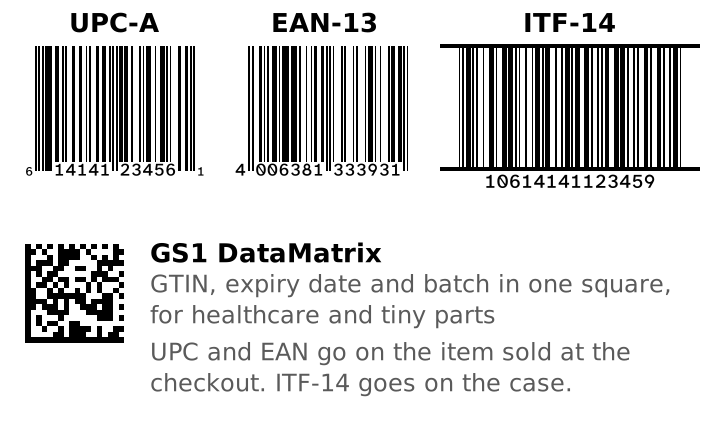
| EAN/UPC: UPC-A, UPC-E, EAN-13, EAN-8 | A GTIN of 8, 12 or 13 digits | Must be used on every item scanned at a retail checkout; reads in any direction |
| GS1 DataBar, 7 variations | A 14 digit GTIN, and in the Expanded forms up to 74 digits or 41 letters of extra data | Fresh food, coupons and small items; 4 of the 7 can be scanned at a checkout |
| ITF-14 | A 14 digit GTIN only | Cases and cartons that do not pass a checkout; suited to printing on corrugated board |
| GS1-128 | Up to 48 characters, with application identifiers for dates, batches and the SSCC | Cases, pallets and shipping labels; not for the checkout |
| GS1 DataMatrix | Up to 3,116 digits or 2,335 characters | Healthcare items, direct part marking and tiny parts; the only 2D code allowed on regulated healthcare products |
| GS1 QR Code, and QR Code or Data Matrix with a GS1 Digital Link web address | Up to 7,089 digits or 4,296 characters in a QR | Packaging that links a phone to product information, and the checkout from 2027 |
| GS1 DotCode | No fixed limit | Only for the EU tobacco tracking regulation |
The rule that matters most to a seller is the first row. GS1 says the EAN/UPC family must be used for anything a checkout scans. It adds that ITF-14 and GS1-128 are for goods that stay in the supply chain. A carton therefore gets an ITF-14, while the item inside it gets a UPC or EAN.
Which of these the generators draw
The UPC generator and the EAN-13 generator draw the EAN/UPC family, including UPC-E and EAN-8. The ITF-14 generator draws carton codes with their bearer bars. The GS1 mode of the Data Matrix generator draws a GS1 DataMatrix with a GTIN, expiry date, batch and serial number. GS1 DataBar, GS1-128 and GS1 DotCode are not among the tools. The Code 128 generator makes plain Code 128, which a GS1-128 scanner setup will not read as GS1 data.
Checking who holds a number
GS1 runs a free lookup called Verified by GS1. Type a GTIN and it reports whether the number is correctly built, whether GS1 issued it, and which company licensed it. Marketplaces use the same data to validate new listings. If you are offered a cheap number by a reseller, that lookup shows whose name it is registered under before you print anything.
The checkout moves to 2D
GS1 has set what it calls an ambition: that retail checkouts around the world can read 2D barcodes by the end of 2027. GS1 US calls the program Sunrise 2027 and says it is not necessary to implement everything by that date. During the changeover a 2D code is added beside the UPC or EAN, never instead of it. A store whose scanners are not ready can then still ring the product up. GS1 US says plainly that the UPC barcode is not going away. What a 2D barcode is covers the formats and sizes involved.
Getting a GS1 number
In the US, on its price list of 2 November 2026, GS1 US sells a single GTIN for $30 with no renewal. On the same list, GS1 US sells a company prefix from $250 for 10 numbers plus $50 a year. Other countries license through their own GS1 member organization. The guide to getting a UPC code walks through the purchase, the Data Hub and what each marketplace asks for. The number you receive is explained in what a GTIN is.
What happens when one of these symbols meets a scanner is in how barcodes work. The story of the first of them, the UPC, is in who invented the barcode.
More about GS1 barcodes
Is a UPC a GS1 barcode?
Yes, when the number inside it was licensed through GS1. The UPC is the oldest member of the family, and GS1 says every item scanned at a checkout must carry an EAN or UPC symbol.
Does a GS1 barcode hold the price?
No. It holds the number, and in some symbols a date, batch or serial number. The price and the product name sit in the retailer's database, which is why the same code rings up differently in two stores.
Is GS1 a government agency?
No. It is a standards organization formed in 2005 when the US Uniform Code Council and EAN International merged. EAN had been set up in Brussels in 1977 as a not-for-profit standards body.
Do I need software from GS1 to make the barcode?
No. GS1 licenses the number. Any tool that follows the General Specifications can draw the bars, including GS1's own Data Hub, a label printer's software, or the generators here.
10 source documents
- GS1: About GS1, fetched 2 November 2026
- GS1: How we got here: 50 years of GS1, fetched 2 November 2026
- GS1: General Specifications, Release 26.0, sections 1.2.2.2.1, 4.15.4, 5.1 to 5.8 and 8.2, fetched 2 November 2026
- GS1: Barcodes overview, fetched 2 November 2026
- GS1: GS1 DataBar, fetched 2 November 2026
- GS1: 1D barcodes for general distribution: GS1-128 and ITF-14, fetched 2 November 2026
- GS1: 2D barcodes, fetched 2 November 2026
- GS1: Verified by GS1, fetched 2 November 2026
- GS1 US: Sunrise 2027, fetched 2 November 2026
- GS1 US: How to get a UPC barcode, with prefix pricing, fetched 2 November 2026