What is a SKU (stock keeping unit)?
A SKU, or stock keeping unit, is a code your business makes up for one exact thing you stock, down to its size and color. No one issues it and no one else has to understand it, which is what makes it different from a UPC.
By the UPC Generator team. Written from GS1 US guidance, the platform documents listed at the end, and the rules the SKU generator applies. Last updated 4 November 2026. How UPC Generator pages are made.
What a SKU is for
A SKU answers one question: exactly which thing is this? Your stock count, reorder list and sales report all depend on that answer. A medium red shirt and a large red shirt are one product to a shopper's eye, but they sell at different rates. If they share a code, you find out you are out of mediums when a customer tells you.
Because you invent the code, you choose what goes in it. That freedom is also how lists turn messy, so it helps to settle the format before you make the first code.
SKU, UPC and the rest
| Code | Who creates it | Who understands it | Does it say what the item is? |
|---|---|---|---|
| SKU | You | You and your software | Yes, if you design it to |
| UPC or EAN | You, from a number licensed through GS1 | Every retailer and marketplace | No, it is a key for lookups |
| ASIN | Amazon | Amazon | No |
| Serial number | The maker | Anyone, for that one unit | No, and each single unit gets its own |
A SKU names a kind of thing, so every medium red shirt shares one. A serial number names one single unit. A UPC code also names a kind of thing, but it does so in a form that works outside your business.
What a good SKU looks like
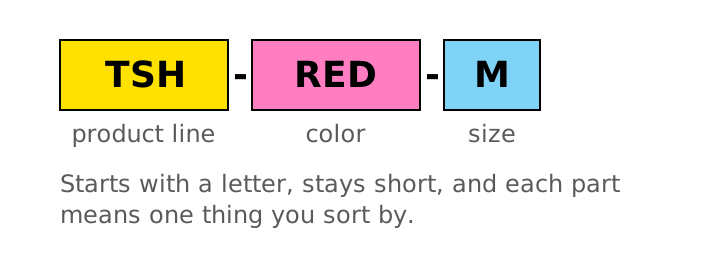
TSH-RED-M is easy to read: product line, color, size. Four rules cover most of what goes wrong.
- Start with a letter. A spreadsheet reads a column of digits as numbers and drops leading zeros, so 00721 turns into 721 with no warning.
- Keep it short. Aim for 8 to 12 characters. Every character adds width to a barcode, and a Code 128 label at a 0.33 mm narrow bar grows by 3.63 mm per character.
- Stay with letters, digits and one separator. Spaces and symbols cause trouble when you import a list, and they can break a web address.
- Avoid mix-ups when you can. O next to 0 and I next to 1 are the usual misreads when someone keys a code by hand.
Setting up SKUs in an afternoon
Write down the parts your business actually sorts by, most important first. A clothing seller might use product line, color and size. A parts seller might use category and a running number. Then pick one short form for each value and record it: RED always means red, and BLK always means black, on every product.
The SKU generator does the multiplying once you have your lists. Three colors and four sizes make 12 codes. It flags duplicates and leading zeros, and gives you a CSV to import. To label shelves or bins, it draws any code as a Code 128 barcode.
When you sell in more than one place
Keep the same SKU across your own store, marketplaces and spreadsheets. It becomes the link that ties your sales and stock together when each platform has its own product IDs. Check a platform's rules before you settle on a long format. eBay publishes a limit of 50 characters, Shopify advises no more than 16, and Amazon says SKUs are usually 8 to 10 letters and numbers.
A SKU never replaces a UPC where a retailer or marketplace asks for one. For that you need a licensed number, which how to get a UPC code explains.
Changing a SKU later
Avoid it where you can, because old orders and reports still use the old code. If you must change one, keep a two-column list of old and new, and do not reuse a retired code for a different product. A reused code makes your old sales history look like it belongs to the new item.
Once the codes exist, where to find a SKU number shows where each platform keeps them. The label route through Excel or Word turns a list into printed labels.
More about SKUs
What does SKU stand for?
Stock keeping unit. In speech people say each letter, S K U, or sometimes the word skew.
Is a SKU the same as a UPC?
No. You make up a SKU for your own use. A UPC is built from a number licensed through GS1, and it means the same thing in every store.
Where do I find the SKU number on a product?
Often you will not. A SKU is the seller's own code. So it may appear on the shelf tag, the receipt or the seller's website rather than on the package. Two stores usually have different SKUs for the same product.
Do I need SKUs if I sell only a few products?
They help as soon as you have sizes or colors, or sell in more than one place. Starting while the list is short costs a few minutes, and fixing a messy list later costs far more.
Can two products share a SKU?
They should not. A SKU exists to tell things apart, and sharing one means your counts stop meaning anything. If two products are truly the same, that is one SKU.
5 source documents
- GS1 US: How to get a UPC barcode: each variation needs a unique barcode, fetched 2 November 2026
- Shopify: SKUs, help center, fetched 2 November 2026
- eBay: Trading API AddFixedPriceItem, SKU length, fetched 2 November 2026
- Amazon: SKU definition guide, fetched 2 November 2026
- Wikipedia: Stock keeping unit, fetched 2 November 2026