How to get a UPC code
In the US, a UPC number registered to your company comes from GS1 US. One number costs $30 with no renewal fee on GS1 US's price list of 2 November 2026. A retailer can look up who holds that number, and whether you need one depends on where you sell.
By the UPC Generator team. Prices come from the GS1 US pricing table, and marketplace rules from each marketplace's own documents, listed at the end. Last updated 4 November 2026. How UPC Generator pages are made.
Where you sell decides it:
- Amazon: a product ID such as a UPC for most categories, or a GTIN exemption approved in the listing process.
- Walmart Marketplace: a UPC licensed through GS1, because Walmart checks the number against GS1's records.
- Your own store, stock room or mock-ups: no UPC at all, a SKU of your own is enough.
Three kinds of number
| Number | Where it comes from | Fits |
|---|---|---|
| Licensed through GS1 | GS1 US, or your country's GS1 office | Anything sold through retailers or marketplaces that ask for one |
| Bought from a reseller | A third party selling numbers it holds | Ask first whose name the number is registered under |
| Internal, starting with 4 | You, from the range GS1 keeps for use inside a company | Your own stock, tests and mock-ups |
If your goods will never leave your own shelves, the third kind is free and you can make the barcode right now, and how to make a barcode compares the ways to draw it. The rest covers the first kind.
What GS1 US charges
| Numbers you need | First payment | Each year after |
|---|---|---|
| 1 | $30 | $0 |
| 10 | $250 | $50 |
| 100 | $750 | $150 |
| 1,000 | $2,500 | $500 |
| 10,000 | $6,500 | $1,300 |
| 100,000 | $10,500 | $2,100 |
Those are the prices GS1 US listed on 2 November 2026, and it says they may change, so check its page before you buy. Other countries set their own through their local GS1 office.
A single $30 number suits a few products. It has limits: GS1 US says it is not available for drugs, goods sold by weight, mixed cases or coupons. A prefix suits a growing line, and GS1 US names cases and pallets among what it lets you number. GS1 US says your product data stays linked to your company as long as you renew the membership each year.
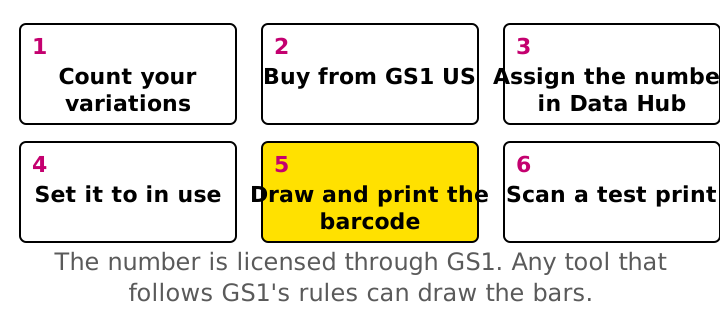
The route, step by step
- Count your variations. Each size, color, flavor and pack count needs its own number. GS1 US has a barcode estimator if you are unsure.
- Buy from GS1 US. Pick a single number or a prefix, give your contact details, and pay.
- Assign the number. Log in to its Data Hub, add the product, and let it assign the number.
- Set it to in use when you are ready to share the product with retailers and marketplaces.
- Get the barcode. Data Hub gives you a PNG. You can also type your licensed number into the UPC generator for an SVG or PDF at the size your printer or designer needs. Your number stays your number, whichever tool draws the bars.
- Print a test and scan it before you run a batch. The check digit tool will catch a mistyped digit first.
What each marketplace actually asks for
Rules differ, and the differences decide whether you need a licensed number at all. These summaries come from each platform's own help pages.
| Platform | What its documents say |
|---|---|
| Walmart Marketplace | Every item needs a product ID. Walmart checks each one against the GS1 database, removes listings that fail, and can suspend the account. It advises getting IDs directly from GS1, and handmade or private label goods can request an exemption |
| Amazon | Most products need a product ID. If you create your own product, it points you to GS1, and you can apply for a GTIN exemption, which it says usually takes about 48 hours per product category |
| eBay | Identifiers are required in most categories, and you can choose Does not apply when a product has none |
| Google Merchant Center | Asks for a GTIN only if one was assigned, and says never to make one up. It rejects numbers from the internal and coupon ranges, such as those starting 04 |
| Shopify | The barcode field is optional. A barcode registered with GS1 is marked as a GTIN, and you get a warning if the product name and vendor do not match the GS1 record |
| Physical stores | GS1 says retailers often require UPCs that come specifically from it. Ask each buyer for its rule, since no public rule covers them all |
So it depends where you sell. Walmart is the clearest case for a licensed number. On Amazon and eBay, a product with no number can have a route without one. Check the page for your own marketplace, because these rules change.
What about cheap barcodes from resellers?
Resellers offer numbers for less than GS1 does. Before you buy, ask whose name the number is registered under. GS1 US says a retailer who looks up your UPC sees the company that licensed it. If the number belongs to another company or is not found, you risk rejection or the cost of relabeling. Walmart treats an item registered to a company unrelated to the brand as invalid.
GS1's rules are also strict about reuse. Since 1 January 2019 its General Specifications have barred reassigning a GTIN to a different item, with two narrow exceptions. If $30 from the source looks expensive, compare it with relabeling a production run.
When you can skip a UPC
You do not need a licensed number if you only sell directly. That covers craft markets, your own website with your own stock system, and your own counter. In those cases a SKU tracks your stock, and it needs no license at all. Skipping the license is only for goods that never reach a retailer. A made-up number must never go on goods for sale as if it were licensed. Books are a separate system too. An ISBN comes from the national agency where you publish, and it can be printed as a barcode with no GS1 membership.
After you have your number
Print it at 100 percent or larger if you can, keep the clear space, and use dark bars on a light background. The UPC generator shows the size and warns about anything risky. For a case or carton of the same product, the ITF-14 generator builds its number from yours. If you hold a single number rather than a prefix, check with GS1 US first. The digits you just bought are explained in what a UPC code is.
The number you buy is a GTIN, and what a GTIN is explains the four lengths it comes in. The organization behind the license is described in what a GS1 barcode is, and books follow their own route through the ISBN barcode guide.
More about getting a UPC
How much does a UPC code cost?
On its price list of 2 November 2026, GS1 US charges $30 for a single number with no renewal fee. A prefix for 10 numbers costs $250 and then $50 a year, and larger sizes run up to $10,500. GS1 US can change these prices, so check its page before you buy.
Can I use a free number instead of buying one?
You can make the barcode for free. A number you make up is fine for your own stock labels, tests and mock-ups. It is not registered to anyone, so a marketplace that checks GS1 records, as Walmart does, will reject it.
Do I need a UPC to sell on Amazon?
Amazon says most products need a product ID such as a UPC, and it points sellers of their own products to GS1. If your product has none, you can apply for a GTIN exemption in the listing process. Amazon says approval usually takes about 48 hours per category.
How long does it take to get a UPC?
GS1 US says its welcome email arrives within minutes of checkout. You then enter the product and assign a number in its Data Hub tool, and download the barcode image.
How many UPC codes do I need?
One for each variation. GS1 US gives the example of a shirt in 3 sizes and 3 colors, which needs 9. Count every size, color, flavor and pack count you sell.
12 source documents
- GS1 US: How to get a UPC barcode, with prefix pricing, fetched 2 November 2026
- GS1 US: Create a barcode, fetched 2 November 2026
- GS1 US: What is a GS1 Company Prefix, fetched 2 November 2026
- GS1: Can a GTIN be reused?, fetched 2 November 2026
- GS1: GS1 Company Prefix list, fetched 2 November 2026
- Walmart Marketplace: Choose a product identifier, fetched 2 November 2026
- Amazon: GTIN guide, fetched 2 November 2026
- Amazon: Selling generic products, GTIN exemption timing, fetched 2 November 2026
- eBay: Product identifiers, seller center, fetched 2 November 2026
- Google: Merchant Center, GTIN, fetched 2 November 2026
- Shopify: Barcodes, help center, fetched 2 November 2026
- International ISBN Agency: ISBN bar coding, fetched 2 November 2026