Does a barcode set off store alarms?
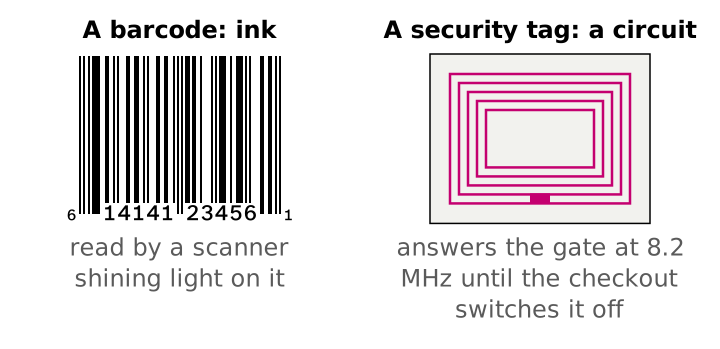
No. A barcode is printed ink, and the only thing that reads it is a scanner pointed at it. The pedestals at a store exit look for something else entirely. They listen for a security tag or label that answers a radio or magnetic signal, usually at 8.2 MHz or about 58 kHz. The checkout is supposed to switch that tag off.
By the UPC Generator team. Written from Wikipedia's article on electronic article surveillance, product and explainer pages from Sensormatic and Checkpoint Systems, and a GS1 document on RFID-based security. None of the listed documents says a barcode triggers a gate, and three of them explain the one link that exists. Last updated 4 November 2026. How UPC Generator pages are made.
What the gate is listening for
The pedestals at a store door are one half of an electronic article surveillance system. The other half is a tag or label on the goods. The pedestals send out a signal and listen for a tag that answers it. If a live tag passes between them, the alarm sounds. Staff are meant to remove the tag or switch it off when the item is paid for.
There are a few kinds of tag, and none of them is printed. A radio frequency label is a tiny coil and capacitor circuit tuned to 8.2 MHz, the retail standard. The gate sweeps that frequency looking for the dip the circuit makes. Acousto-magnetic tags hold two small metal strips that ring at about 58 kHz when the gate sends a burst. The electromagnetic strip, the kind libraries use, responds to a low frequency magnetic field. An RFID label carries a serial number that the gate reads and checks against a list of items not yet sold. That is the system GS1 describes in its own document on RFID security. The first such tags were invented by Arthur Minasy in 1964 and patented in 1970.
Why a barcode cannot trigger it
A barcode carries a number and nothing else, as how barcodes work explains. It is ink on paper or plastic, with no circuit, no metal strip and no chip. The gate sends out a radio or magnetic field and waits for something to answer, and ink does not answer. Of the vendor, encyclopedia and GS1 documents behind these answers, not one says a UPC or EAN barcode sets off a gate.
The one real link between the two
Three of those sources describe the connection that makes the question reasonable. In grocery stores, the device that switches off a radio frequency label is often built into the barcode scanner at the till. Checkpoint, which sells those systems, says its deactivators are installed as part of the checkout scanner. The label is switched off in the same single action as scanning the barcode. Wikipedia says the same: RF deactivation built into flat and vertical barcode scanners is common in food retail.
So the barcode scan and the tag deactivation happen together, which is why they get confused. The pad under the scanner switched the label off, by pushing enough voltage through its circuit to break it, and the barcode played no part. Acousto-magnetic labels are switched off by demagnetizing one of their strips instead. Sensormatic says its pads do that up to 10 cm above the surface. Wikipedia puts remote deactivation of an RF label at up to about 30 cm.
Why alarms go off anyway
Most tags on packaged goods are applied at the factory, which the trade calls source tagging. Wikipedia says the most common source tags are acousto-magnetic strips and 8.2 MHz radio frequency labels. It adds that most manufacturers use both in the United States. A label hidden inside a box can be missed by the pad, and a very small label can be hard to deactivate consistently. At a self-checkout the step can be skipped. Checkpoint says some grocers deactivate tags in bulk only when payment completes, to stop items being scanned and carried out unpaid.
Then there is the tag that was never meant for that store. Each shop switches off only the kind of tag its own system uses, and a shop with no gate switches off none. A live tag in a bag from another store sets off the next gate it passes. Wikipedia says this tag pollution is often why someone triggers an alarm on the way in rather than the way out.
For anyone printing barcodes
Nothing you make with a barcode generator can set off a gate. If a retailer requires source tagging, that is a separate label with its own specification. It is bought from a security vendor and placed where the retailer's certification center says. Your barcode's only job is to carry the right number at the right size. The UPC generator and the GS1 barcode guide are for that.
To read a barcode yourself at the door, how to scan a barcode with your phone shows the routes. How the stripes got there in the first place is in who invented the barcode.
More about barcodes and store alarms
Can a barcode work as a security tag?
No. A security tag has to answer the gate's signal, and ink on paper cannot. The tag is a separate circuit or metal strip, sometimes hidden inside the packaging, and the barcode is just the printed number.
Why did the alarm go off after I paid?
Usually a tag that was never switched off. It may be a label the deactivator missed, one too small for the pad, or a self-checkout that skipped the step. It can also be a live tag from another store, which Wikipedia calls tag pollution.
Do library books use the barcode as the alarm?
No. Libraries mostly use a thin magnetic strip, often called tattle tape, that is switched off at the desk. The barcode on the book is read separately to record the loan.
Does an RFID label replace the barcode?
Not at the checkout. An RFID label carries a serial number the gate can check against a database, which GS1 describes. The printed barcode still carries the product number that the till reads and prices.
6 source documents
- Wikipedia: Electronic article surveillance, fetched 2 November 2026
- Checkpoint Systems: RF EAS deactivation, fetched 2 November 2026
- Checkpoint Systems: Deactivation and detection: EAS in grocery, fetched 2 November 2026
- Sensormatic: Electronic article surveillance overview, fetched 2 November 2026
- Sensormatic: Label deactivators, fetched 2 November 2026
- GS1: EPCglobal RFID-based EAS strategic overview, 2009, fetched 2 November 2026