What is a GTIN number?
A GTIN, or Global Trade Item Number, is the number printed under the bars on a product. It comes in four lengths: 8, 12, 13 and 14 digits. A UPC carries the 12 digit kind and an EAN the 13 digit kind. The product keeps the same number whether it sells alone or in a case of 24.
By the UPC Generator team. Based on the GS1 General Specifications, Release 26.0, the GS1 GTIN Management Standard and GS1 US pages. The carton numbers shown are produced by the same code as the ITF-14 generator and match GS1's worked example. Last updated 4 November 2026. How UPC Generator pages are made.
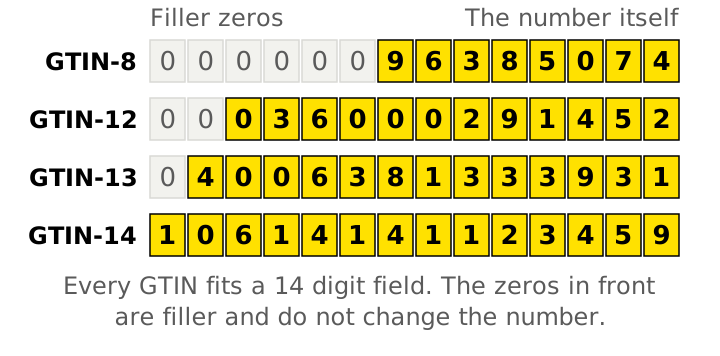
Four lengths, one job
| Kind | Digits | Barcode that carries it | Where it goes |
|---|---|---|---|
| GTIN-8 | 8 | EAN-8 | Packs too small for an EAN-13, issued one at a time by a GS1 office |
| GTIN-12 | 12 | UPC-A or UPC-E | Products at the checkout, mostly in North America |
| GTIN-13 | 13 | EAN-13 | Products at the checkout, mostly everywhere else |
| GTIN-14 | 14 | ITF-14 or GS1-128 | Cases and multipacks that never cross a checkout |
All four do one job: they name a trade item. GS1 defines that as anything that can be priced, ordered or invoiced at any point in a supply chain. Every item that differs from another in design or content gets its own number. A medium red shirt and a large red shirt are two trade items, so they need two GTINs.
The number names a kind of thing, never a single unit. A tube of toothpaste has the same GTIN whether it sits on a shelf alone or inside a case of 12 or 24. The case itself gets a different number, because a store orders and counts it separately.
How the digits are built
A GTIN has three parts. The GS1 Company Prefix comes first, a string of 4 to 12 digits that GS1 licenses to one company. The item reference follows, chosen by the company for each product, and GS1 asks that it carry no hidden meaning. The last digit is the check digit, worked out from everything before it.
In the US the prefix is handed over as a U.P.C. Company Prefix, which is the GS1 prefix with its leading zero dropped. GS1's own example is the 7 digit prefix 0614141, which becomes the 6 digit U.P.C. prefix 614141 and builds 12 digit numbers. The guide to UPC codes shows how those 12 digits become bars.
The same number in a longer box
A UPC-A can be read as a 13 digit number by putting a zero in front of its GTIN-12. That is how a US product scans in a European store. GS1 goes one step further for databases: any GTIN can be stored as 14 digits by adding zeros at the front. Those zeros are filler and do not change the number.
| Kind | 14 digit form | Zeros added |
|---|---|---|
| GTIN-8 | 000000 + the 8 digits | 6 |
| GTIN-12 | 00 + the 12 digits | 2 |
| GTIN-13 | 0 + the 13 digits | 1 |
| GTIN-14 | The 14 digits as they are | 0 |
One catch: a GTIN-12 can itself begin with one or more zeros, such as the prefix 000510. Those zeros belong to the company prefix and must be kept, so never trim zeros off a number you were given.
The GTIN-14 and its indicator digit
A GTIN-14 is built from an item's existing number. Take the GTIN without its check digit, put an indicator digit from 1 to 8 in front, and work out a new check digit. GS1 says the indicators have no meaning. A company picks them as it likes, need not use them in order, and can make up to eight case codes for one item. Indicator 9 is reserved for goods sold by weight or length, and GS1 US says a real GTIN-14 never starts with 0.
GS1's worked example uses the item number 0614141123452. With indicator 1 the carton number is 10614141123459, and with indicator 8 it is 80614141123458. The ITF-14 generator does this sum from your own item number, and the check digit tool shows the working for any of the four lengths.
When a product needs a new GTIN
GS1's GTIN Management Standard sets out when a changed product keeps its number and when it needs a fresh one. A new number is required if any one of three things holds. A shopper or trading partner is expected to tell the new version from the old. A law or liability rule requires the change to be declared. Or the change affects how the product is shipped, stored or received.
Ten rules apply that test. A brand new product always gets a new number. So does a change to the declared net content, such as 680 g to 794 g. So does a change in a dimension or gross weight of more than 20 percent. Adding or removing a certification mark or changing the primary brand needs a new number. So does changing the count in a case or swapping one item in a fixed assortment. Holiday packaging keeps the retail number but gets new case and pallet numbers, and printing a price on the package counts as a change too.
Once a GTIN has been used, GS1 does not let it move to a different product. That rule has applied in every sector since 1 January 2019. This is why a number bought from a reseller may already belong to someone else's product.
GTIN, UPC, EAN and SKU
GS1 US puts it this way: the barcode is the data carrier and the GTIN is the data. A UPC-A carries a GTIN-12, an EAN-13 carries a GTIN-13, and both are GS1 barcodes. A SKU is different in kind, because a retailer invents it for its own stock system. Two shops can sell the same product under the same GTIN and different SKUs.
Getting one and checking one
A GTIN for goods you sell is licensed through GS1. On its price list of 2 November 2026, GS1 US charges $30 for one number with no renewal. On the same list, it charges $250 for a prefix covering 10 numbers and $50 a year after that. The guide to getting a UPC code covers the steps and what each marketplace asks for.
To find out who holds a number, GS1 runs a free lookup called Verified by GS1. It tells you whether the number is properly built, whether GS1 issued it, and which company licensed it. GS1 US warns that numbers from unauthorized third parties may already be tied to another company or product. That lookup is how a retailer finds out.
Drawing a GTIN you already hold
Once you have a licensed number, the UPC generator draws the 12 digit kind and the EAN-13 generator the 13 digit kind. Both draw at the sizes GS1 allows. For your own stock and tests, both tools can fill in a number from the internal-use range instead.
The final digit of every length is worked out the same way, as what a check digit is shows. Which symbol carries which GTIN is in what a GS1 barcode is. The number as it appears on a package is in where the UPC code is on a product.
More about GTINs
Is a GTIN the same as a UPC?
Nearly. The UPC is the barcode, and the GTIN-12 is the 12 digit number inside it. GS1 US says the words get used for each other, and that the barcode is only the carrier.
What does GTIN stand for?
Global Trade Item Number. GS1 defines a trade item as anything that can be priced, ordered or invoiced anywhere in a supply chain. That runs from a raw material to a finished product.
How many digits does a GTIN have?
8, 12, 13 or 14, depending on the kind. Databases usually store every one of them as 14 digits by adding zeros at the front, and those zeros do not change the number.
How do I get a GTIN?
Through GS1. In the US, GS1 US sells one number for $30 with no renewal fee, or a company prefix from $250 for 10 numbers. Other countries go through their own GS1 office.
Can I make up a GTIN for my own stock?
For your own shelves, yes, using the range GS1 keeps for use inside a company. That is prefixes 040 to 049, which is a UPC starting with 4. Those numbers must never go on goods sold to other businesses, and Google Merchant Center rejects them.
7 source documents
- GS1: General Specifications, Release 26.0, sections 1.3.1, 2.1, 4.2 and 5.2.2.3, fetched 2 November 2026
- GS1: GTIN Management Standard, guiding principles and rules 1 to 10, fetched 2 November 2026
- GS1: What is the Global Trade Item Number (GTIN)?, fetched 2 November 2026
- GS1 US: What is a GTIN?, fetched 2 November 2026
- GS1 US: How to get a UPC barcode, with prefix pricing, fetched 2 November 2026
- GS1: Verified by GS1, fetched 2 November 2026
- Google: Merchant Center, GTIN, fetched 2 November 2026