Where is the UPC code on a product?
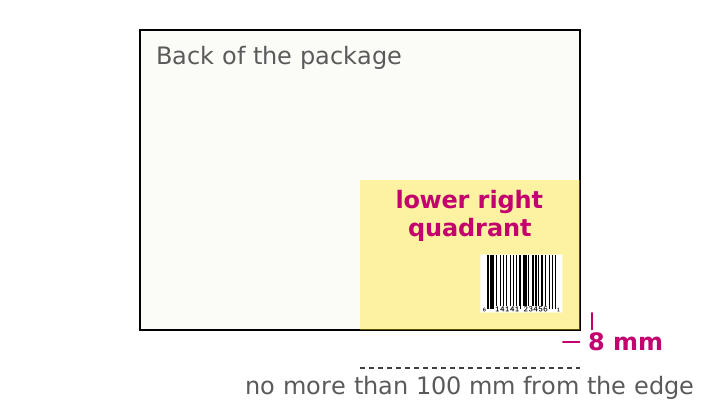
The UPC is the barcode on the back of a package, usually in the lower right quadrant. That is where GS1's placement rules put it. GS1 wants it between 8 mm and 100 mm from the nearest edge. The 12 digit number is printed under the bars, with the first digit standing left of them and the last digit right of them.
By the UPC Generator team. Written from section 6 of the GS1 General Specifications, Release 26.0, and GS1 US placement advice. The product identifier help pages of Amazon, Google Merchant Center and eBay cover the marketplaces. Last updated 4 November 2026. How UPC Generator pages are made.
Where to look first
GS1 calls the front of a package the main trading area, where the name and logo go. It calls the back the preferred place for the barcode on most items. Within the back, the rule is the lower right quadrant. The symbol sits no closer than 8 mm to the nearest edge and no farther than 100 mm from it. GS1 explains the edge rule by how cashiers hold things: they grab bags and packs by the edges with their thumbs. An earlier 5 mm minimum proved too small.
If the back is unsuitable, the alternative is the lower right quadrant of another face. The bottom is still acceptable on small items, but GS1 prefers the back or a side. It rules the bottom out for large, heavy or bulky goods. The reason for all this consistency is the cashier: with hand scanning, a barcode that could be anywhere slows every checkout.
Reading the digits once you find it
A UPC-A prints all 12 digits under the bars. The first and last are set in smaller type outside the guard bars. That is why people sometimes copy only the 10 in the middle and get a number that fails. Copy all 12. An EAN-13 prints 13, with its first digit standing left of the bars, and a UPC-E, the short symbol on small packs, prints 8.
The number is a GTIN. GS1 US reads it as a company prefix of 6 to 10 digits, an item reference of 1 to 5 digits, and a check digit. Its example is 6 14141 99999 6. The first digit is a rough guide to what kind of number it is, in Wikipedia's reading. Under the original UPC number system, as Wikipedia records it, 0, 1 and 6 through 9 were ordinary products, 3 was drugs and 5 was a coupon. Those three meanings are history. The 2 for goods sold by weight and the 4 for a store's internal use still stand, because GS1's list keeps the 02 and 04 ranges for those uses. GS1's current prefix list is the rule today: it puts 03 inside the GS1 US range like any other prefix and holds 05 back. The UPC generator reads that list for any number you type. GS1 is clear that the prefix shows which office licensed the number and not where the product was made. On a book the number comes from the ISBN, and ISBN barcode with a price shows how the price add-on sits beside it. The digits are taken apart in what a UPC code is, and testing the check digit confirms you copied them right.
Packages that move the barcode
| Product | Where GS1 puts the barcode |
|---|---|
| Bags | Center of the back, about a third of the way up from the bottom |
| Bottles and jars | Lower right of the back, never on the neck |
| Boxes | Lower right of the back; lower right of the front as the alternative |
| Cans and tubs | Away from seams, beads and ridges, with the bars running round the curve where needed |
| Carded items in blister packs | Lower right of the back of the card, clear of the product |
| Egg cartons | On the side of the lid |
| Books | Lower right of the back cover, near the spine, with any price add-on to its right |
| Magazines | Lower left of the front cover |
| Thin items such as pizza boxes and writing pads | Lower right of the back, never on the thin edge |
| Clothing and accessories | On a hangtag or a sewn-in label |
Large items get special treatment. GS1 counts anything over 13 kg or with two sides longer than 450 mm as large, heavy or bulky. It allows more than one copy of the same barcode so a scanner can reach one. It also says never to put a barcode over a seam, fold, flap, perforation or tight curve, and never under a flap or a staple.
When you cannot see it
A price sticker over the bars does not change the number printed under them, so lift it or read round it. If the symbol is torn or smudged, the printed digits still work. Type them into a listing or into the UPC generator and the check digit will tell you whether you read them right. A phone reads an intact symbol too, and how to scan a barcode with your phone says which apps do it.
Some products have no UPC at all. Google says a store brand or a product sold by only one company often has none. It adds that you should never guess one and that you can ask the manufacturer. Amazon lets a seller of such goods apply for a GTIN exemption, and eBay accepts Does not apply for items like antiques. Google also refuses the internal ranges, numbers starting 02, 04 or 2, and the coupon ranges, 05, 98 or 99.
Finding the number for a listing
Amazon says to look for the barcode on the packaging or the book cover, and that the number appears above or below it. It may also be printed on the shipping carton the product arrived in. Google's advice is the same, with the lengths spelled out. Use the 12 digits below a UPC, the 13 below an EAN, JAN or ISBN, and the 14 below an ITF-14 carton code. Both say a barcode scanner app can read the number and its type for you.
Keep the three numbers apart. The UPC belongs to the product and is the same in every store. A SKU is the seller's own code. It may be printed on a shelf tag or nowhere at all, as where to find a SKU number explains. An ASIN belongs to an Amazon listing. Only the UPC goes in the product identifier field, and GS1's Verified by GS1 lookup will tell you which company holds it.
The number you find is a GTIN, explained in GTIN lengths and forms. If the product is yours and has no number yet, how to get a UPC code covers the license.
More about finding a UPC
Is the UPC the number on my receipt?
Not usually. None of the GS1 or retailer documents listed here says a receipt prints the UPC. Receipts show the store's own item code or description, so for the UPC go back to the package or the retailer's product page.
Which digits do I type into a listing?
All 12 printed under a UPC barcode, including the small first and last digits outside the bars. Google says to use the 13 digits below an EAN or ISBN and the 14 below an ITF-14. Amazon says the number is above or below the barcode.
Do the first digits show where a product was made?
No. GS1 says the company prefix makes the number unique worldwide but does not identify the origin of the item. It shows which GS1 office licensed the number, nothing more.
Why are there two barcodes on the box?
GS1 says barcodes for two different numbers must never both be visible on one item. Two visible codes usually mean a case code and an item code, or a security label beside the UPC. Large or bulky items may carry the same UPC twice on purpose.
8 source documents
- GS1: General Specifications, Release 26.0, sections 2.1.3.1, 5.2.5, 6.2, 6.3, 6.4 and 6.5, fetched 2 November 2026
- GS1 US: Place barcodes on products, fetched 2 November 2026
- GS1 US: Guide to UPCs, fetched 2 November 2026
- Amazon: What are product IDs or GTINs?, fetched 2 November 2026
- Google: Merchant Center, find a GTIN, fetched 2 November 2026
- Google: Merchant Center, GTIN, fetched 2 November 2026
- eBay: Product identifiers, fetched 2 November 2026
- Wikipedia: Universal Product Code, number system digit, fetched 2 November 2026